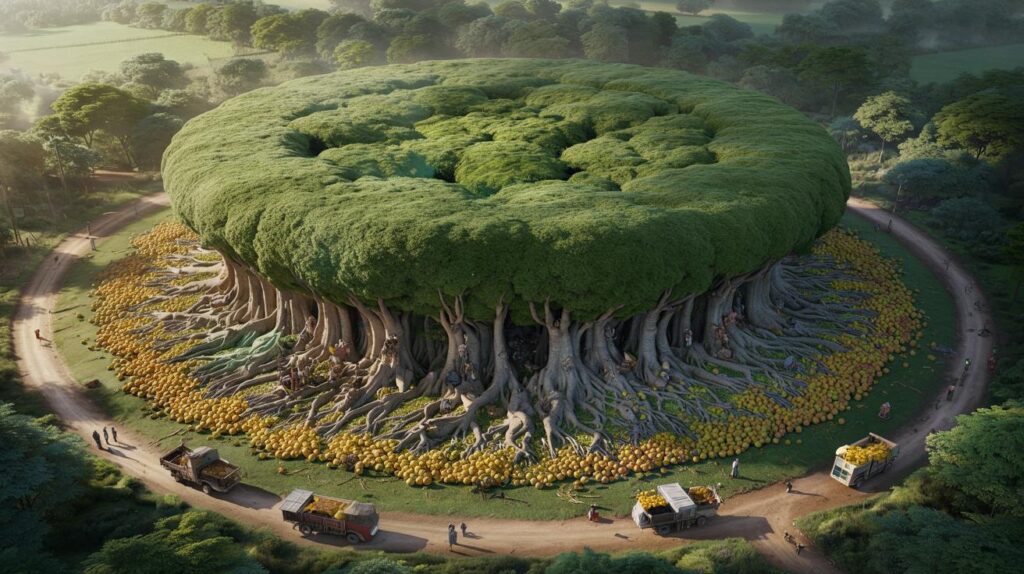
It looks like an entire forest spreading across the landscape, but surprisingly, it is just a single tree. Covering nearly 8,500 square meters, standing 20 meters tall, and producing around 80,000 fruits in one harvest, this natural wonder has fascinated botanists and travelers alike. Its massive canopy stretches so wide that people often mistake it for a small woodland. This extraordinary tree showcases the incredible power of nature, proving how one living organism can create the impression of an entire ecosystem.
Single Tree That Looks Like a Forest
The idea of a single massive tree covering thousands of square meters feels almost unreal. Yet this botanical marvel expands through an intricate network of branches and roots, forming what appears to be a natural green canopy. From above, it resembles a thick woodland, but at its core, it remains one organism. Its expansive root system supports the widespread structure, ensuring stability and nourishment across its vast coverage. Visitors walking beneath it often describe the experience as stepping into a living forest illusion, where light filters gently through layers of leaves. The sheer scale and unity of this tree make it one of the most breathtaking natural formations on Earth.
8,500 Square Meters of Botanical Wonder
Spanning approximately 8,500 square meters, this tree forms a remarkable land coverage rarely seen in a single organism. Its branches stretch horizontally, creating what scientists call a continuous branch network that supports new growth over time. This structure allows the tree to develop a self-sustaining ecosystem beneath its shade, where various plants and small creatures thrive. The tree’s towering height structure of 20 meters further enhances its forest-like presence, making it visible from a great distance. What makes it even more impressive is how seamlessly it maintains balance between growth and stability, adapting naturally to environmental conditions while continuing to expand outward year after year.
80,000 Fruits Per Harvest from One Tree
Producing up to 80,000 fruits in a single season, this tree demonstrates extraordinary productivity. Each harvest reflects its exceptional fruit yield, supported by a strong nutrient flow throughout the structure. The abundance of produce highlights the tree’s seasonal harvest cycle, which ensures consistent regeneration. Thanks to its dense foliage spread, sunlight is efficiently absorbed, fueling the energy needed for such massive output. This level of production from a single organism emphasizes its agricultural significance worldwide. Farmers and researchers study trees like this to better understand sustainable growth, resilience, and how natural systems can maximize both coverage and productivity.
Why This Tree Is a Natural Phenomenon
What makes this tree truly extraordinary is its ability to combine size, productivity, and longevity in one unified organism. It stands as a rare biological marvel, showcasing how nature can scale beyond expectations. Its vast spread creates a microclimate environment beneath the canopy, offering shade and habitat for countless species. Over time, its growth reflects a long-term growth pattern that ensures stability and renewal. Observing such a structure reminds us of nature’s incredible design and the global ecological importance of preserving remarkable plant life that supports biodiversity and inspires scientific curiosity.
| Feature | Details |
|---|---|
| Total Coverage Area | 8,500 square meters |
| Tree Height | 20 meters |
| Fruits per Harvest | 80,000 fruits |
| Structure Type | Single connected organism |
| Environmental Role | Provides shade and habitat |
Frequently Asked Questions (FAQs)
1. Is it really one single tree?
Yes, despite its forest-like appearance, it is one interconnected organism.

2. How does it cover such a large area?
Its branches and roots expand outward over time, creating widespread coverage.
3. Does it produce fruit every year?
Yes, it follows a seasonal cycle that allows consistent fruit production.
4. Why is this tree considered unique?
Its combination of massive size, height, and fruit yield makes it exceptionally rare.