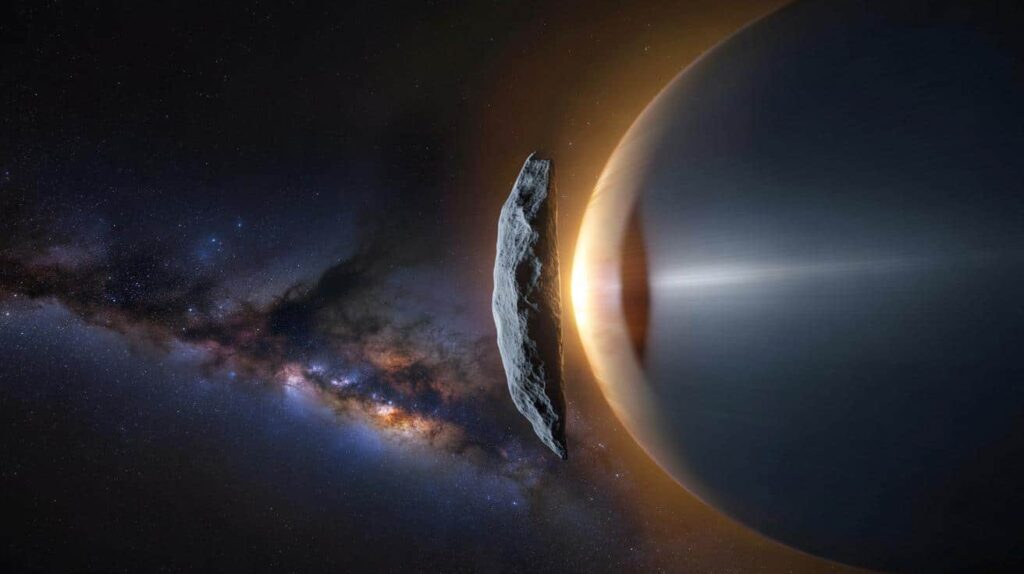
Scientists have identified a mysterious object from another solar system racing toward us at record speed, sparking intense global curiosity. Unlike typical comets or asteroids that originate within our own cosmic neighborhood, this newly detected body appears to have traveled across interstellar space before entering our region. Researchers say the discovery offers a rare chance to study material formed around a distant star. With powerful telescopes tracking its trajectory, experts are now analyzing its composition, origin, and potential scientific value for understanding the broader universe.
Interstellar Object Discovery Stuns Astronomers Worldwide
The newly detected visitor has been classified as an interstellar object, meaning it originated beyond our solar system. What makes it extraordinary is its record-breaking velocity, far exceeding the speed of typical comets bound by our Sun’s gravity. Early calculations suggest it follows a hyperbolic trajectory, confirming it is not orbiting but simply passing through. Observatories quickly coordinated a global telescope network to monitor its brightness and motion. Scientists are particularly excited because objects like this are extremely rare, offering a fleeting opportunity to examine matter formed in entirely different stellar environments.
Record-Speed Space Visitor Offers Rare Research Opportunity
Traveling at astonishing speed, this cosmic traveler provides a snapshot of conditions from another star system. Its unusual orbit pattern suggests it was likely ejected by gravitational interactions long ago. Researchers are studying its surface composition clues using spectroscopy to determine whether it resembles icy comets or rocky asteroids. The object’s stellar origin mystery has fueled fresh debate about how often material is exchanged between star systems. Every bit of data collected during its brief passage could reshape current theories about planetary formation beyond our own Sun.

What This Another Solar System Object Means for Science
This extraordinary encounter marks only the second confirmed visitor of its kind in modern observation history. Scientists believe such events may be more common than once thought, but detecting them requires precise instruments and rapid response. The object’s extreme entry speed suggests it has traveled for millions, perhaps billions, of years through deep space. Studying its alien material samples remotely could reveal chemical signatures unlike those found locally. Ultimately, this discovery strengthens the case for future space missions designed to intercept similar objects and collect direct measurements.
Why This High-Speed Interstellar Encounter Matters
The appearance of a fast-moving object from beyond our stellar neighborhood highlights how dynamic and interconnected the universe truly is. Each rare astronomical event like this expands our understanding of planetary systems forming around distant stars. The data gathered may improve models of solar system evolution and reveal how debris travels across interstellar space. With advancing detection tools and faster data sharing, researchers hope to identify the next incoming object even sooner. For now, this remarkable discovery serves as a reminder that space still holds countless cosmic exploration opportunities waiting to be uncovered.
| Feature | Observed Detail |
|---|---|
| Origin | Outside our solar system |
| Trajectory | Hyperbolic, not gravitationally bound |
| Speed | Faster than typical comets |
| Scientific Value | Insights into distant star systems |
| Observation Method | Ground and space telescopes |
Frequently Asked Questions (FAQs)
1. What is an interstellar object?
An interstellar object is a space body that originates outside our solar system and passes through it.

2. Why is this object considered unusual?
It is traveling at record speed and follows a hyperbolic path, proving it is not bound to our Sun.
3. Can this object collide with Earth?
Current tracking data shows no risk of collision with Earth.
4. What can scientists learn from it?
Researchers can analyze its composition to understand planetary formation in distant star systems.