More than a century ago, Albert Einstein suggested that time is not fixed but flexible, shaped by gravity and motion. Today, that theory is no longer just abstract science — Mars missions have provided measurable proof that time flows differently on the Red Planet. As space agencies plan longer expeditions and even human settlements, this subtle but powerful difference is becoming impossible to ignore. Understanding how clocks tick on Mars compared to Earth is now critical for navigation, communication, and the future of deep space exploration.
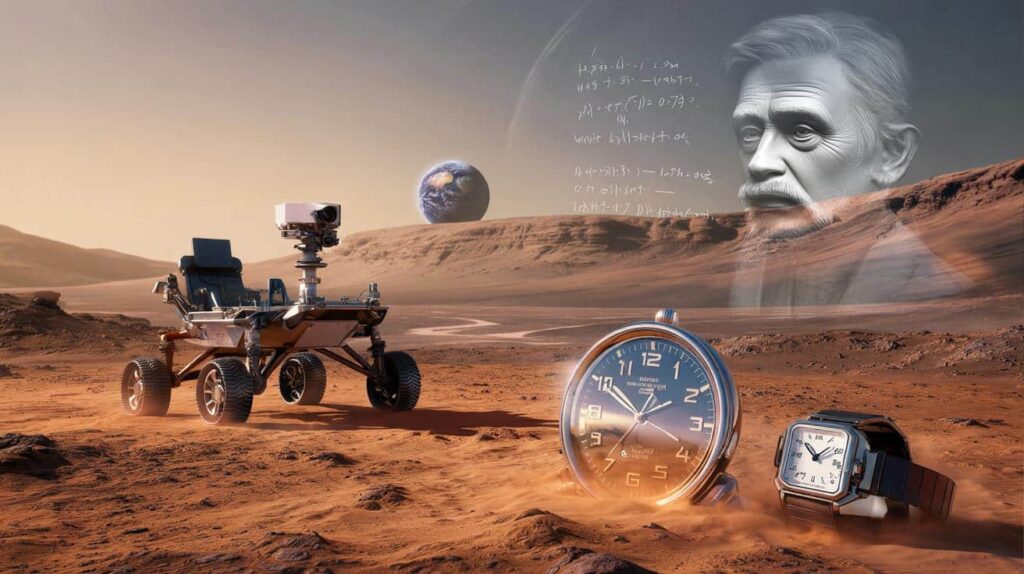
Time Flows Differently on Mars Due to Einstein’s Relativity
Einstein’s theory of relativity predicted that time would shift depending on gravity and speed, and Mars offers a fascinating real-world example. Because the planet has weaker gravity and moves differently in orbit, spacecraft experience gravitational time dilation that slightly alters clock readings. Scientists also account for orbital velocity shifts when calculating precise landing sequences. Even a tiny variation matters when signals travel millions of kilometers. These differences create measurable clock synchronization gaps between planets. Over extended missions, these micro-changes accumulate into what researchers call planetary time drift, forcing engineers to recalibrate onboard systems with extreme precision.
Mars Time Difference Reshapes Future Space Missions
The discovery that time flows differently on Mars isn’t just scientific trivia — it directly impacts mission planning. Rovers, orbiters, and future astronauts rely on precision navigation systems that demand perfect timing. Communication delays already challenge operations, but now engineers must factor in relativistic timing offsets when coordinating commands. A slight miscalculation could disrupt deep space coordination during landing or docking maneuvers. As agencies design habitats and long-term missions, maintaining interplanetary clock alignment becomes essential for safety and reliability. The Red Planet is essentially teaching us that timekeeping must evolve alongside exploration technology.

Why Time on the Red Planet Forces Technological Adaptation
Mars operates on a slightly longer day than Earth, but relativity adds another layer of complexity. Engineers now develop adaptive mission software capable of correcting subtle variations automatically. Without these adjustments, signal transmission errors could multiply across years of operation. Future colonies may even adopt Mars-based time standards rather than relying on Earth clocks. This shift requires upgraded spacecraft atomic clocks built for extreme precision. In many ways, Mars is pushing humanity toward a new era where timekeeping technology must match the realities of multi-planet living.
The Bigger Picture of Time Flow on Mars
What once sounded like science fiction is now measurable reality. The fact that time flows differently on Mars reinforces how dynamic the universe truly is. As exploration expands, relativity in action will influence everything from navigation to communication. These findings highlight the importance of long-duration mission planning and the need for next-generation calibration tools. Ultimately, understanding this cosmic time variation prepares humanity for deeper journeys into space. Mars has become more than a destination — it is a proving ground for mastering time itself.
| Factor | Earth | Mars |
|---|---|---|
| Gravity Strength | Stronger gravitational pull | Weaker gravitational pull |
| Length of Day | 24 hours | 24 hours 39 minutes |
| Time Dilation Effect | Minimal at surface | Slightly greater variation |
| Clock Adjustment Need | Standard calibration | Relativistic corrections required |
| Mission Planning Impact | Conventional timing systems | Advanced synchronization systems |
Frequently Asked Questions (FAQs)
1. Why does time flow differently on Mars?
Because differences in gravity and orbital motion create measurable relativistic effects on clocks.

2. Is the time difference noticeable to humans?
The variation is extremely small but crucial for spacecraft and navigation systems.
3. How do space missions adjust for this difference?
Engineers use highly accurate atomic clocks and software corrections to maintain synchronization.
4. Will future Mars colonies use a different time system?
Future settlements may adopt Mars-based time standards adapted to the planet’s longer day.