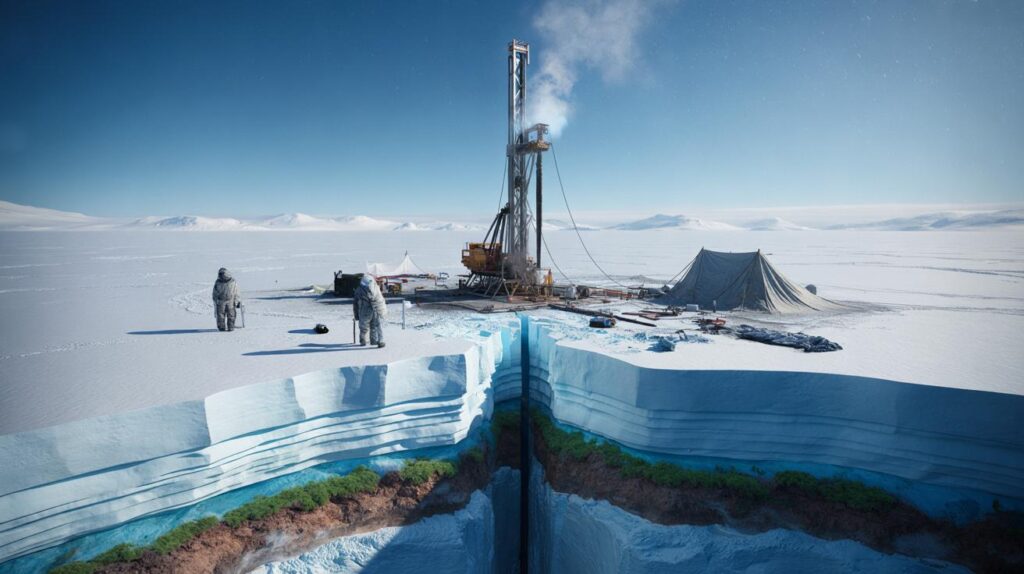
In a discovery that feels straight out of science fiction, researchers have uncovered a hidden landscape buried beneath nearly two kilometers of Antarctic ice. This lost world, estimated to be around 34 million years old, offers a rare glimpse into Earth’s distant past—long before massive ice sheets reshaped the southern continent. Using advanced radar mapping and deep ice-penetrating technology, scientists revealed ancient river valleys, mountain ridges, and preserved terrain frozen in time. The find is reshaping how experts understand early climate shifts and the dramatic transformation of Antarctica.
Lost World Beneath Antarctic Ice Reveals Ancient Landscape
The newly uncovered terrain beneath the thick Antarctic ice sheet has stunned researchers with its remarkable preservation. Hidden under layers of ice for millions of years, the region contains what experts describe as ancient river valleys, carved long before glaciers dominated the continent. Advanced scanning techniques detected buried mountain ranges and rugged highlands, forming a dramatic frozen prehistoric terrain. This discovery suggests Antarctica once experienced a far warmer and dynamic environment. The untouched landscape, sealed by ice, offers a rare geological archive that could transform scientific understanding of Earth’s early ecosystems and continental evolution.
34-Million-Year-Old Antarctic Discovery Changes Climate History
Dating back roughly 34 million years, this hidden world formed during a pivotal era when global temperatures began dropping significantly. Scientists believe the preserved land reflects conditions from a pre-ice sheet era, before permanent glaciation took hold. By analyzing sediment layers and structural formations, researchers are building a clearer picture of early climate transitions. The discovery provides insight into how the ice age onset permanently reshaped landscapes and ecosystems. More importantly, this natural time capsule helps experts study global temperature shifts that influenced sea levels and biodiversity across the planet.

Scientists Use Advanced Technology to Explore Antarctica’s Hidden World
Unlocking this ancient landscape required cutting-edge tools capable of peering through massive ice layers. Teams deployed ice-penetrating radar mounted on aircraft to scan the terrain beneath the surface. The resulting high-resolution mapping revealed intricate landforms previously thought erased by glacial movement. This breakthrough demonstrates the power of subglacial exploration in uncovering secrets hidden for millions of years. Researchers also rely on deep ice core data to confirm the region’s age and environmental history, piecing together clues that could refine future climate models.
What This 34-Million-Year-Old Lost World Means for the Future
Beyond its dramatic appeal, this discovery carries profound implications for science. By studying a landscape sealed off since ancient times, researchers gain valuable context for understanding long-term planetary change. The preserved features act as a climate change blueprint, illustrating how Earth responded to dramatic cooling millions of years ago. Insights drawn from this geological time capsule may improve predictions about modern ice stability. As investigations continue, experts anticipate more revelations from this hidden polar frontier, reshaping discussions around future sea level risks and environmental resilience.
| Aspect | Key Information |
|---|---|
| Estimated Age | Approximately 34 million years old |
| Ice Thickness Above | Nearly 2 kilometers |
| Main Features Found | River valleys, mountains, highlands |
| Technology Used | Radar imaging and ice core analysis |
| Scientific Importance | Improves understanding of ancient climate shifts |
Frequently Asked Questions (FAQs)
1. How old is the buried Antarctic landscape?
It is estimated to be around 34 million years old.

2. How was the lost world discovered?
Scientists used advanced ice-penetrating radar and mapping technology.
3. Why is this discovery important?
It helps researchers understand ancient climate transitions and ice formation.
4. What lies beneath the ice?
The terrain includes preserved river valleys, mountain ranges, and ancient landforms.